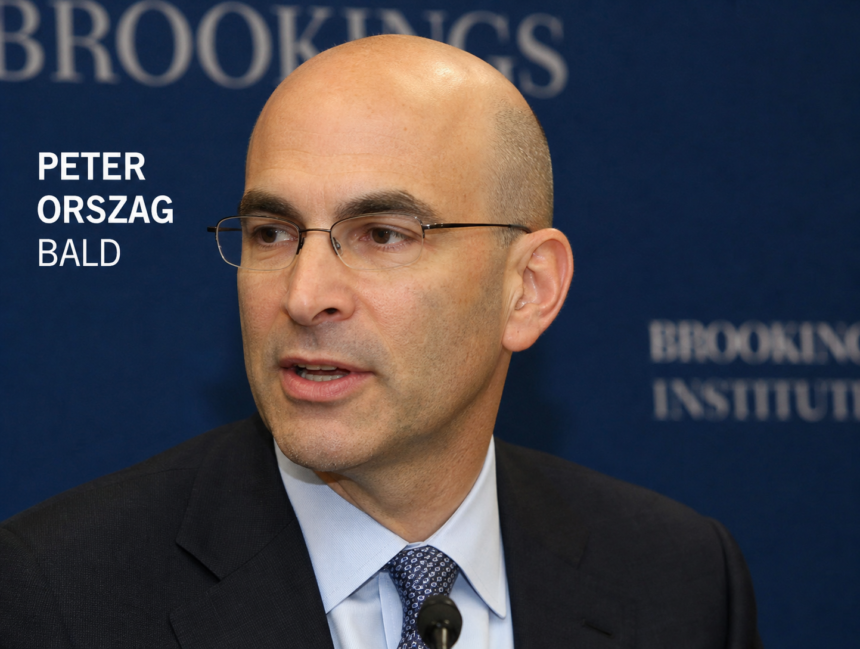
You’ve probably seen his face on CNBC, in the pages of the Financial Times, or across the dais at some high-stakes policy forum in Washington. The receding hairline is hard to miss — and honestly, it’s become something of a trademark. But if the only thing you know about Peter Orszag is that he’s bald, you’re missing the story of one of the most influential economic minds of the last two decades.
Peter Orszag has held more positions of real power before the age of 55 than most people accumulate in an entire lifetime. He ran the Congressional Budget Office. He managed the federal budget under President Obama during the worst financial crisis since the Great Depression. And today, he sits at the helm of Lazard, one of the oldest and most prestigious financial advisory firms on the planet. The hair may have thinned over the years, but his influence has only grown thicker.
Profile Summary
| Detail | Information |
|---|---|
| Full Name | Peter Richard Orszag |
| Age | 56 (born December 16, 1968) |
| Birthplace | Boston, Massachusetts, USA |
| Profession | Economist, CEO of Lazard |
| Net Worth | Estimated $20–50 million |
| Education | Princeton University (BA), London School of Economics (MSc, PhD) |
| Nationality | American |
| Marital Status | Married to Bianna Golodryga |
| Known For | Former OMB & CBO Director, Lazard CEO, fiscal policy expert |
The Quick Answer: Is Peter Orszag Bald?
Yes — and he’s been open about it in the casual, unbothered way that most confident public figures handle their appearance. Photos from the late 1990s show a younger Orszag with a fuller head of hair, but by the time he stepped into the CBO director’s office in 2007, the thinning was already well underway. Today, his closely cropped, receding hairline is simply part of his look.
There’s no public record of hair transplants, medical treatments, or any particular drama surrounding his hair loss. It’s the kind of natural male pattern baldness that affects roughly two-thirds of American men by age 60. Orszag, for his part, has never made it a topic of discussion — which, frankly, says a lot about where his focus has been.
If you landed on this article because you typed “Peter Orszag bald” into Google out of curiosity, fair enough. But stick around, because the rest of his story is far more interesting than his hairline.
Read More: Lisa Roughead
Early Life: Growing Up in an Academic Powerhouse
Peter Orszag was born in Boston in 1968 into a family that practically breathed academia. His father, Steven Orszag, was a legendary applied mathematician at Yale University — the kind of scholar whose name appears in textbooks. His mother was also deeply involved in intellectual circles.
This wasn’t a household where dinner conversation revolved around sports scores. The Orszag kids grew up around equations, policy debates, and the quiet intensity of people who took ideas seriously. Peter’s brother, Jonathan Orszag, went on to become a well-known economist in his own right, co-founding the consulting firm Compass Lexecon.
The family’s Hungarian-Jewish roots also shaped their worldview. The Orszag name traces back to Eastern Europe, and the family’s emphasis on education and public service carries echoes of that heritage.
Peter attended Phillips Exeter Academy, one of the most competitive prep schools in the country, before heading to Princeton University. At Princeton, he graduated summa cum laude in economics — a detail that matters because it signals the kind of intellectual horsepower he brought to every role that followed. He then crossed the Atlantic to the London School of Economics, where he earned both a master’s degree and a PhD in economics.
By his mid-twenties, Orszag had the credentials that most economists spend entire careers chasing.
The Brookings Years: Building a Reputation
Before he ever set foot in government, Orszag spent time at the Brookings Institution, one of Washington’s most respected think tanks. This is where he started developing the policy chops that would later define his career.
At Brookings, he focused heavily on Social Security reform, retirement savings, and the long-term fiscal trajectory of the United States. These aren’t exactly cocktail-party topics, but they’re the kinds of issues that determine whether a country can afford to take care of its aging population. Orszag became known for his ability to translate dense budgetary data into clear, actionable policy recommendations.
He also co-authored several books during this period, including Saving Social Security: A Balanced Approach with Peter Diamond, a Nobel Prize-winning economist. Working alongside Diamond gave Orszag a level of credibility that few young economists could match.
Running the CBO: The Scorekeeper of Congress
In 2007, House Speaker Nancy Pelosi tapped Orszag to lead the Congressional Budget Office. This was a bigger deal than most people realize.
The CBO is the nonpartisan agency that “scores” legislation — meaning it calculates how much a proposed law will cost or save the federal government over time. Every major piece of legislation that moves through Congress gets a CBO score, and that number can make or break a bill’s chances of passing. When the CBO says a healthcare reform plan will cost $900 billion over ten years, that figure dominates the news cycle for weeks.
Orszag ran the CBO during a period of extraordinary turbulence. The housing market was collapsing. Credit markets were freezing. And Congress was scrambling to figure out how to respond. His team produced cost estimates for the early bailout proposals and stimulus packages that would shape the government’s response to the 2008 financial crisis.
He earned a reputation for being meticulous, data-driven, and refreshingly unwilling to bend numbers to suit political narratives. In Washington, that kind of integrity is rarer than you’d think.
The OMB Director: Managing the Federal Checkbook During a Crisis
When Barack Obama won the presidency in 2008, one of his first major appointments was Peter Orszag as Director of the Office of Management and Budget. The OMB is essentially the White House’s internal accounting department — it drafts the president’s budget, oversees federal spending across all agencies, and plays a central role in shaping economic policy.
Orszag walked into the job in January 2009, right as the economy was in freefall. Unemployment was skyrocketing past 8% and heading toward 10%. The auto industry was on the brink of collapse. The banking system was still fragile despite the initial TARP bailouts.
His first major task was helping to design and justify the American Recovery and Reinvestment Act — the $787 billion stimulus package that became one of the most consequential (and debated) pieces of economic legislation in modern history. Orszag was the one who had to stand in front of cameras and explain why the government needed to spend nearly a trillion dollars at a time when the deficit was already exploding.
He also pushed hard for healthcare cost containment, arguing that the long-term fiscal health of the country depended on slowing the growth of Medicare and Medicaid spending. This put him at the center of the Affordable Care Act negotiations, though his focus was more on the cost side than the coverage side.
Orszag left the OMB in 2010, after about 18 months in the role. His departure was somewhat abrupt, and there was speculation at the time about friction with other White House economic advisors, particularly Larry Summers. Orszag himself said he was exhausted and wanted to return to the private sector.
The Citigroup Chapter: From Government to Wall Street
After leaving Washington, Orszag joined Citigroup as Vice Chairman of Global Banking — a move that raised eyebrows among some ethics watchdogs. The “revolving door” between government and Wall Street is a perennial source of controversy, and Orszag’s transition from regulating the financial system to working for one of its biggest players drew criticism.
At Citi, Orszag focused on advising the bank’s corporate and government clients on strategic decisions, particularly around healthcare, infrastructure, and fiscal policy. His value to the bank was obvious: he understood how Washington worked at a granular level, and he could help Citi’s clients navigate the intersection of public policy and private capital.
He spent over a decade at Citigroup, steadily building his reputation as one of the most connected and intellectually rigorous figures in the financial industry. His compensation during this period was substantial — reports suggest he earned tens of millions of dollars over his tenure — which significantly boosted his personal net worth.
Taking the Reins at Lazard
In 2023, Orszag made his biggest career move yet: he became CEO of Lazard, the storied financial advisory firm founded in 1848. Lazard is not a household name like Goldman Sachs or JPMorgan, but within the world of mergers and acquisitions, sovereign debt restructuring, and high-level corporate strategy, it carries enormous prestige.
Lazard has advised governments on debt crises, helped orchestrate some of the largest corporate mergers in history, and maintained a reputation for intellectual rigor over raw balance-sheet size. In many ways, it was a perfect fit for Orszag — a firm that values analytical depth and policy sophistication over sheer scale.
His appointment signaled Lazard’s ambition to expand beyond its traditional M&A advisory roots and build out its asset management and strategic consulting capabilities. Orszag has spoken publicly about wanting to position Lazard as a firm that can help clients navigate an era of geopolitical uncertainty, rising interest rates, and the energy transition.
Personal Life: Marriage, Family, and Public Profile
Peter Orszag married journalist Bianna Golodryga in 2010, shortly after leaving the Obama administration. Golodryga is a well-known television correspondent who has worked for ABC News, CBS News, and CNN. The couple’s wedding was a notable event in Washington media circles, bringing together figures from politics, journalism, and finance.
They have two children together and maintain a relatively private family life despite their high public profiles. Orszag occasionally appears on Golodryga’s network segments when economic policy is in the news, which has led to some lighthearted commentary about power couples in the media-policy world.
As for his appearance — yes, the bald look has become more pronounced over the years. But if you watch his interviews and public appearances, you’ll notice that his physical presence carries a different kind of authority. He speaks with the calm precision of someone who has spent decades being the smartest person in the room and no longer feels the need to prove it.
What Makes Orszag Different From Other Economists?
The economics profession is full of brilliant people who can model macroeconomic trends and debate monetary policy until the sun comes up. What sets Orszag apart is his ability to operate effectively across three very different worlds: academia, government, and Wall Street.
Most economists excel in one of these arenas. Some are great researchers but terrible communicators. Others thrive in government but struggle to adapt to the private sector. Orszag has managed to build genuine credibility in all three, which gives him a kind of versatility that’s extremely rare.
He’s also a prolific writer for a general audience. His columns in Bloomberg Opinion and his contributions to various policy journals demonstrate an ability to make complex fiscal issues accessible without dumbing them down. If you want to understand why healthcare costs are eating the federal budget alive, Orszag’s writing is one of the best entry points available.
Net Worth and Financial Standing
Estimating the net worth of private-sector executives is always imprecise, but most credible sources place Peter Orszag’s net worth somewhere between $20 million and $50 million. The bulk of this wealth was accumulated during his years at Citigroup, where senior vice chairmen routinely earn eight-figure annual compensation packages.
His current role as CEO of Lazard likely comes with a significant base salary, performance bonuses, and equity grants, which will continue to grow his net worth in the coming years. He also owns real estate in New York City and the Washington, D.C. area, though specific details about his property holdings are not publicly available.
It’s worth noting that Orszag’s wealth trajectory is a textbook example of the government-to-Wall-Street pipeline. His deep policy expertise, built during years of relatively modest government salaries, became enormously valuable once he transitioned to the private sector. Whether you view that as a feature or a bug of the American system depends on your politics.
Key Career Milestones at a Glance
| Year | Milestone |
|---|---|
| 1991 | Graduated summa cum laude from Princeton University |
| 1997 | Earned PhD from the London School of Economics |
| 2001 | Joined the Brookings Institution as a senior fellow |
| 2007 | Appointed Director of the Congressional Budget Office |
| 2009 | Became Director of the Office of Management and Budget under Obama |
| 2010 | Left government, joined Citigroup as Vice Chairman |
| 2023 | Appointed CEO of Lazard |
Frequently Asked Questions
Is Peter Orszag completely bald?
No. He has thinning hair and a receding hairline, but he is not fully bald. His hair has thinned progressively over the years, which is typical for men in their fifties.
What is Peter Orszag’s current job?
He is the Chief Executive Officer of Lazard, a global financial advisory and asset management firm headquartered in New York City. He assumed the role in 2023.
How old is Peter Orszag?
He was born on December 16, 1968, making him 56 years old as of 2025.
Is Peter Orszag related to Jonathan Orszag?
Yes. Jonathan Orszag is his younger brother. Jonathan is also an economist and co-founded the consulting firm Compass Lexecon.
Why did Peter Orszag leave the Obama administration?
Orszag resigned from the OMB in 2010, citing exhaustion after an intense 18 months managing the federal budget during the financial crisis. He subsequently joined Citigroup.
What is Peter Orszag’s educational background?
He holds a bachelor’s degree from Princeton University and both a master’s degree and a PhD in economics from the London School of Economics.
Who is Peter Orszag married to?
He is married to journalist Bianna Golodryga. They wed in 2010 and have two children.
The Bottom Line
Peter Orszag’s hair may have retreated over the years, but his career has done the exact opposite. From the halls of Princeton to the budget office of the White House to the corner office at one of Wall Street’s most prestigious firms, he has built a trajectory that few economists — bald or otherwise — could match.
If you came here looking for gossip about his appearance, you probably got more than you bargained for. But the real takeaway is this: the man behind the receding hairline has shaped fiscal policy, navigated a global financial crisis, and now leads a 175-year-old institution through one of the most uncertain economic periods in modern history. That’s a story worth paying attention to — regardless of what’s happening on top of his head.