You can love your partner and still feel strangely far apart. Maybe your conversations have become a running list of school pickups, groceries, bills, and bedtime. Maybe you’re both exhausted, but somehow each person feels the other isn’t doing enough.
That doesn’t automatically mean something is seriously wrong with your relationship. Parenting and child-related stress can spill into couple communication and relationship satisfaction, according to research involving parents.
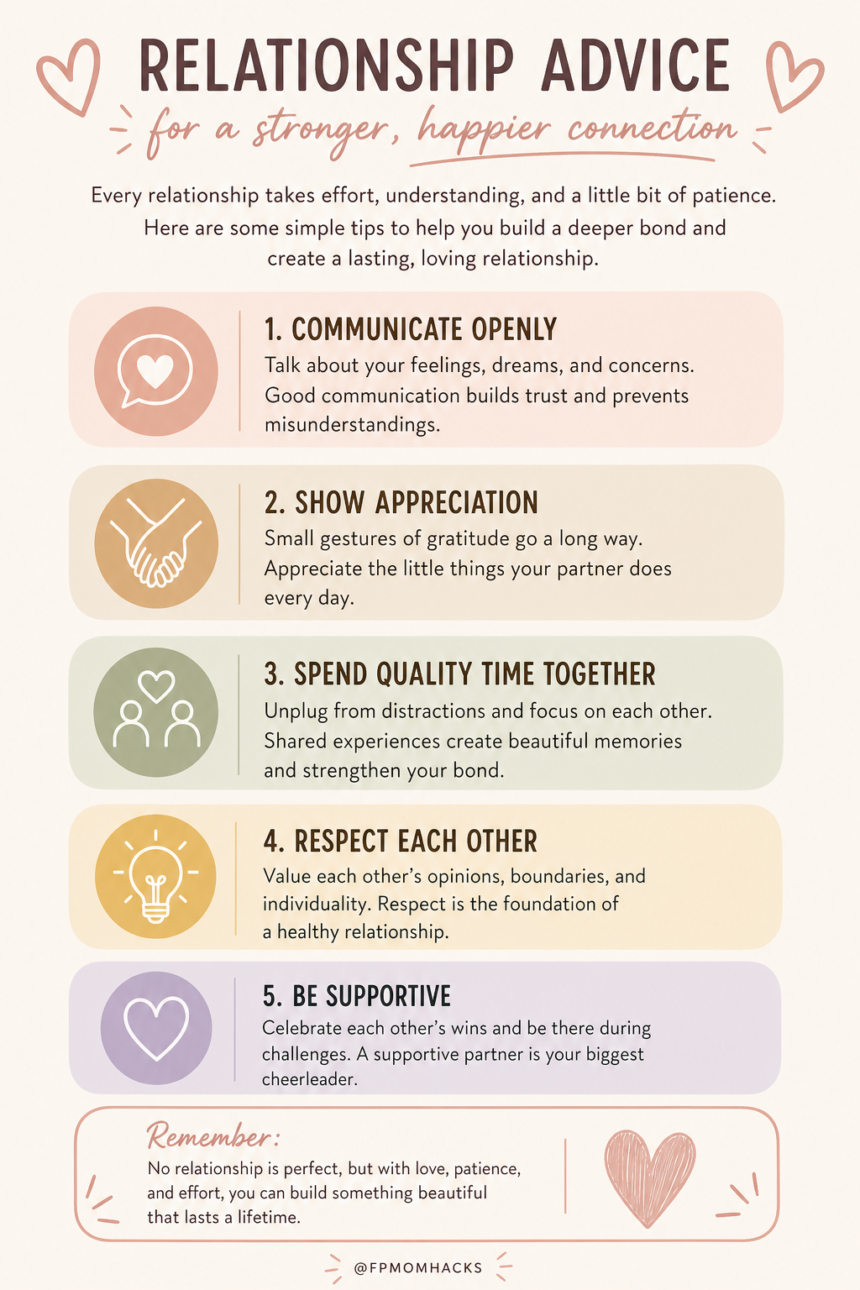
That’s where relationship advice fpmomhacks becomes useful: not as a promise of a perfect relationship, but as a collection of small, realistic habits that busy parents can actually try.
What Relationship Advice FPMomHacks Is Really About
The current FPMomHacks approach focuses heavily on small connection habits rather than elaborate date nights or major relationship overhauls.
Its relationship advice includes ideas such as a short daily conversation, dividing uninterrupted personal time between parents, creating small “couple pockets” during ordinary days, and separating household logistics from emotional conversations.
That philosophy makes sense for a simple reason: a strategy that requires three hours of free time isn’t very helpful to a parent who barely has 30 minutes.
The better question isn’t, “How can we have a perfect date night?”
It’s:
“What can we do with the 5, 10, or 15 minutes we actually have?”
Why Parenting Can Put Pressure on a Relationship
Having children changes the practical structure of a relationship.
Sleep may become less predictable. Household work increases. Financial pressure can change. One partner may feel responsible for remembering appointments, school events, meals, or family schedules while the other feels overwhelmed by work.
Research supports the idea that child-related stress can affect the couple relationship. One study of 118 parental couples found that higher child-related stress was associated with lower relationship satisfaction, with couple communication playing a mediating role.
That doesn’t mean having children inevitably damages a relationship.
It means stress can change how partners interact, which makes communication and cooperation worth protecting.
The “roommate” feeling
A common pattern looks like this:
- “Can you pick up the kids?”
- “We’re out of milk.”
- “Did you pay that bill?”
- “What time is soccer?”
- “Who’s doing bedtime?”
These conversations are necessary. But if nearly every interaction becomes logistical, partners can gradually stop checking in as two people.
FPMomHacks addresses this by separating practical coordination from genuine connection. Its relationship tips recommend dedicated logistics conversations so routine planning doesn’t consume every other conversation.
Relationship Advice FPMomHacks: 7 Practical Strategies
1. Try a 10-Minute Daily Check-In
You don’t need to discuss your entire relationship every night.
Start with ten minutes.
Put the phones away and ask:
- What was the best part of your day?
- What was difficult?
- What do you need tomorrow?
- Is there anything you want me to know?
The goal isn’t to solve everything. It’s to understand what’s happening in your partner’s life.
The FPMomHacks relationship advice page similarly recommends a short daily conversation without turning it into another discussion about childcare or household administration.
Try this: Set a timer for 10 minutes. When it ends, you’re done. Keeping the commitment small makes it easier to repeat.
2. Create a Weekly Logistics Meeting
This may sound unromantic, but it can actually protect your relationship.
Pick 15–20 minutes once a week to discuss:
- Work schedules
- Childcare
- School activities
- Appointments
- Grocery needs
- Bills
- Household chores
- Upcoming commitments
Write everything down in a shared calendar if necessary.
The benefit is simple: important logistics have somewhere to go.
That means Tuesday evening doesn’t have to become another meeting about who’s picking up the children.
FPMomHacks recommends this kind of weekly logistics sync for busy parents.
3. Give Each Other Genuine Off-Duty Time
One of the most useful relationship hacks for parents is also one of the least glamorous.
Give your partner uninterrupted time.
For example:
- Saturday: Partner A gets 90 minutes alone.
- Then Partner B gets 90 minutes alone.
“Alone” should actually mean alone. A person who’s technically off duty but still answering questions about snacks, laundry, or school bags isn’t getting much of a break.
The FPMomHacks relationship article uses a similar “you’re on / you’re off” approach, where one parent takes responsibility for the children while the other gets genuine personal time.
This can also address the mental load—the invisible responsibility of remembering and organizing family tasks.
4. Build Small “Couple Pockets”
Waiting for a two-hour date night can create an all-or-nothing approach to connection.
Instead, look for tiny moments.
Examples include:
- Drinking coffee together without phones
- Sharing a joke during dinner
- Taking a short walk
- Giving your partner a longer hug
- Sending a funny message during the workday
- Sitting together for five minutes after the children go to bed
These aren’t replacements for meaningful quality time. They’re small opportunities to maintain emotional connection between larger moments.
FPMomHacks describes this idea as finding “couple pockets” throughout an otherwise crowded day.
5. Change How You Start Difficult Conversations
Compare these two openings:
“You never help with bedtime.”
With:
“I’m feeling overwhelmed by bedtime. Can we figure out a better way to divide it?”
The second statement describes the problem without immediately attacking the other person.
The Gottman Institute’s relationship resources similarly emphasize expressing what you need rather than simply reacting with anger, alongside turning toward one another and repairing after conflict.
This doesn’t guarantee a calm conversation.
It simply gives the conversation a better starting point.
6. Listen Before Trying to Fix
When your partner says, “I’m exhausted,” your first instinct might be to offer a solution.
“Go to bed earlier.”
“Take tomorrow off.”
“I can handle dinner.”
Sometimes that’s useful.
But sometimes your partner simply wants to feel heard.
Try:
“That sounds like a really rough day. Do you want me to listen, help solve it, or give you some space?”
That one question can prevent a surprising number of misunderstandings.
7. Repair After Arguments
Healthy couples aren’t couples who never disagree.
They still get irritated. They misunderstand each other. They occasionally say something badly.
The useful skill is repair.
A repair attempt can be as simple as:
- “That came out harsher than I meant.”
- “Can we restart?”
- “I understand why that upset you.”
- “I’m still frustrated, but I don’t want us fighting like this.”
- “Let’s take a break and come back to this.”
Relationship research and established couples-therapy frameworks place significant attention on constructive conflict and repairing connection after disagreements.
A Step-by-Step Relationship Reset
If you’re not sure where to start, don’t try all seven strategies at once.
Step 1: Identify the biggest problem
Ask yourself:
What is hurting our connection most right now?
Is it:
- Lack of time?
- Unequal chores?
- Constant arguments?
- Parenting disagreements?
- Poor communication?
- Stress?
- Lack of affection?
- Feeling ignored?
Choose one.
Step 2: Choose one small intervention
Match the problem to a practical action.
| Problem | First strategy to try |
|---|---|
| No meaningful conversation | 10-minute daily check-in |
| Constant scheduling arguments | Weekly logistics meeting |
| One partner feels exhausted | Protected off-duty time |
| Little affection | Daily couple pocket |
| Arguments escalate quickly | Softer conversation opening |
| Partner feels unheard | Listen-before-fixing rule |
| Arguments linger | Repair attempt |
Step 3: Make it specific
Don’t say:
“We need to communicate better.”
Say:
“After the children are asleep on Tuesday, we’ll talk for 10 minutes with our phones away.”
Specific plans are easier to follow.
Step 4: Test it for one week
Don’t demand a dramatic transformation after one conversation.
Try the habit several times.
Then ask:
- Did we actually do it?
- Did it reduce tension?
- Did we feel more connected?
- What made it difficult?
- What should we change?
Step 5: Keep what works
If the habit helps, keep it.
If it doesn’t, adjust it.
Relationship advice should be flexible enough to fit the people actually living the relationship.
Two Real-World Examples
Example 1: The exhausted working parents
Imagine both partners work full time and have two young children.
Their evenings are dominated by dinner, homework, cleanup, and bedtime. By 9:30 p.m., they’re both exhausted.
They try a traditional date night once a month, but planning childcare becomes another source of stress.
A more practical experiment would be a 10-minute nightly check-in plus one protected 60–90 minute personal block for each partner during the weekend.
The goal isn’t to recreate their pre-parenthood relationship. It’s to create predictable opportunities for communication and recovery.
This approach is consistent with the broader FPMomHacks emphasis on small, repeatable habits.
Example 2: The couple arguing about chores
Suppose one partner feels they’re doing most of the household work.
The other partner believes they’re contributing plenty.
If they discuss the issue only when someone is already angry, the conversation can quickly become a competition over who has done more.
Instead, they could hold a weekly logistics meeting and list recurring responsibilities.
Then they can discuss ownership rather than vague complaints.
For example:
“Who is responsible for school lunches?”
is easier to act on than:
“You don’t help enough.”
Research on coparenting has found links between communication, cooperation, conflict, and relationship outcomes, although individual studies have limitations and shouldn’t be treated as universal rules for every family.
What FPMomHacks Gets Right—and Where to Be Careful
No relationship-advice site should be treated as a substitute for professional assessment.
Pros
- Practical strategies
- Short, manageable exercises
- Strong focus on busy parents
- Emphasis on communication
- Ideas that don’t require expensive dates
- Easy to adapt to different family schedules
- Encourages consistency rather than perfection
The FPMomHacks material consistently focuses on realistic routines and small interventions rather than elaborate relationship makeovers.
Cons
- Much of the advice is presented as practical experience rather than formal clinical guidance.
- Individual anecdotes aren’t proof that a technique works for every couple.
- Some claims on the site aren’t accompanied by citations to peer-reviewed research.
- The strategies are better suited to ordinary relationship strain than serious relationship crises.
- [unverified — needs source] Claims implying that specific hacks will produce predictable relationship outcomes shouldn’t be treated as established scientific findings.
That’s why the strongest approach is to combine practical advice with evidence-based relationship principles.
What Research Says About Communication and Coparenting
The evidence isn’t limited to lifestyle blogs.
A study published in Family Relations examined 118 parental couples and found that child-related stress was associated with lower relationship satisfaction, with couple communication partly explaining that association.
Another study examining 249 families with young children found evidence of transactional relationships among parents’ relationship satisfaction, coparenting cooperation and conflict, and parent-child relationship satisfaction.
Research involving 57 couples with young children also found that positive parental emotional expressiveness contributed to family functioning and interacted with marital quality in relation to coparenting behavior.
These findings don’t prove that a ten-minute conversation will “fix” a relationship.
They do support a broader principle: communication and coparenting are meaningful parts of family relationship functioning.
When Relationship Hacks Aren’t Enough
There are situations where self-help advice isn’t the appropriate first step.
Consider professional support if you’re dealing with:
- Repeated destructive conflict
- Serious relationship distress
- Infidelity
- Substance misuse affecting the relationship
- Persistent emotional disconnection
- Severe communication breakdown
- Threats, intimidation, or coercive control
- Physical or sexual violence
If there is abuse or an immediate safety concern, the priority isn’t better communication between partners. Safety comes first.
A relationship “hack” should never be used to pressure someone to remain in an unsafe situation.
How to Make Relationship Advice FPMomHacks Work for You
The biggest mistake is collecting relationship tips without actually using them.
You don’t need 25 new habits.
Start with this seven-day experiment:
Day 1: Identify your biggest relationship pressure point.
Day 2: Have a 10-minute conversation without discussing household logistics.
Day 3: Give your partner one specific appreciation.
Day 4: Take one household responsibility completely off their plate.
Day 5: Spend five phone-free minutes together.
Day 6: Hold a short weekly logistics meeting.
Day 7: Ask each other, “What helped this week, and what should we change?”
Then repeat the one or two habits that felt useful.
A simple rule to remember
Connection doesn’t have to be big to be meaningful. It has to be intentional and repeated.
That’s the central idea behind much of the relationship advice fpmomhacks content, and it’s also where practical parenting advice can meet established relationship research.
Internal Linking Opportunities
If you’re publishing this article on a broader parenting or lifestyle site, consider linking naturally to:
- Parenting tips for busy moms
- How to reduce the mental load at home
- Healthy communication for couples
- Family activities that bring parents and children together
- Time-management tips for working parents
These links can create a useful topic cluster around relationships, parenting, family routines, and household management.
Final Takeaway
The most useful relationship advice fpmomhacks isn’t about finding one magical trick. It’s about noticing where everyday stress is pushing two people apart and creating small systems that bring them back into contact. Start with one habit—a 10-minute check-in, protected personal time, a weekly logistics conversation, or a simple repair after conflict—and give it enough time to see whether it genuinely helps your relationship.