You’ve probably watched enough YouTube trading videos to wallpaper your apartment. You’ve bookmarked a dozen “ultimate beginner guides.” And yet, when you actually open your brokerage app, that blinking cursor in the stock search bar still feels like a dare. If that frustration brought you here — searching for whether the FintechZoom.io stock market course can finally bridge the gap between consuming content and making confident trades — you’re in the right place. This isn’t a puff piece. It’s a thorough, structured evaluation built to help you decide with your eyes open.
What Exactly Is FintechZoom.io?
Before we dissect the course itself, let’s ground ourselves in what FintechZoom.io actually is as a platform.
FintechZoom.io operates as a fintech education and financial news platform that covers markets, cryptocurrency, personal finance, and investing trends. It’s carved out a niche by blending real-time market commentary with structured educational content — including its stock market course offering.
Think of it as a hybrid: part financial media outlet, part online trading course provider. That dual identity matters because it means course content is theoretically informed by active market coverage, not just static textbook theory written once and never updated.
Who Is the FintechZoom.io Stock Market Course Designed For?
Not every course fits every learner. Here’s who this one targets most directly:
- Complete beginners who understand that stocks exist but couldn’t explain the difference between a market order and a limit order.
- Intermediate hobbyists who’ve made a few trades but rely on gut feeling or Reddit tips rather than a repeatable strategy.
- Career pivoters exploring whether financial markets could become a professional focus — not just a side interest.
If you already trade options spreads confidently and can read a 10-K filing in your sleep, this course likely won’t challenge you. It’s built for the ascending learner, not the seasoned analyst.
What the Curriculum Actually Covers
This is where most reviews fail you — they list vague module titles and move on. Let’s go deeper.
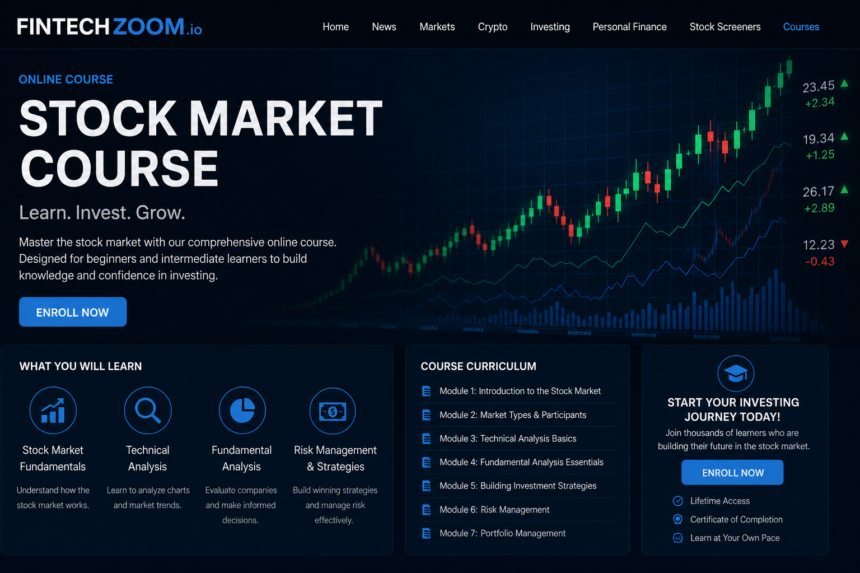
Based on available course descriptions and platform content [Note: FintechZoom.io periodically updates its curriculum; verify the latest module list on their site before enrolling], the FintechZoom.io stock market course typically covers:
Core Modules
- Stock Market Fundamentals — What exchanges are, how price discovery works, the role of market makers, and types of securities (equities, ETFs, bonds).
- Reading Financial Statements — Income statements, balance sheets, cash flow analysis. This is where fundamental analysis training begins.
- Technical Analysis & Chart Patterns — Candlestick chart patterns, support/resistance levels, moving averages, RSI, MACD, and volume analysis.
- Building an Investment Strategy — Distinguishing between active trading and long-term investing, and frameworks for choosing your approach.
- Risk Management in Trading — Position sizing, stop-loss strategies, the psychology of drawdowns, and why most retail traders blow up accounts.
- Portfolio Management Skills — Diversification principles, asset allocation, rebalancing schedules, and correlation awareness.
- Practical Application — Paper trading exercises, brokerage account setup walkthroughs, and simulated trade journals.
Supplementary Content
- Market news digests tied to course concepts (leveraging FintechZoom.io’s media arm)
- Periodic webinars or live Q&A sessions [unverified — needs source; availability may vary by enrollment tier]
- Community forums or discussion boards for peer interaction
Step-by-Step: What the Enrollment-to-Completion Journey Looks Like
Nobody else seems to walk you through this, so here it is — the actual experience from signup to applying what you learn.
Step 1: Registration & Onboarding
Visit FintechZoom.io and navigate to their education or courses section. You’ll create an account (email + password), select the stock market course, and complete payment. Expect a welcome email with login credentials and a suggested learning path.
Step 2: Assess Your Starting Point
Most structured courses — and this one follows the pattern — begin with a self-assessment or introductory module designed to gauge your existing financial literacy. Don’t skip it. It helps you identify which modules to spend extra time on versus which you can breeze through.
Step 3: Sequential Module Completion
Work through the core modules in order. The curriculum is designed so that each section builds on the previous one. Trying to jump to technical analysis before you understand what a stock actually represents is like learning guitar solos before you can tune the instrument.
Pro tip: Take notes as if you’ll have to teach someone else the material tomorrow. That forces active processing, not passive watching.
Step 4: Paper Trading Practice
This is the most critical step and where most learners either level up or drop off. After the technical and fundamental analysis modules, you should open a paper trading account (most brokerages like TD Ameritrade’s thinkorswim, Webull, or Interactive Brokers offer free simulators).
Apply what you’ve learned. Track trades in a journal. Document your reasoning before entering each position and your emotional state during and after.
Step 5: Transition to Real Capital (Carefully)
Once you’ve paper traded for a meaningful period (at least 30–60 days with consistent results), the course’s risk management module becomes your lifeline. Start with a small allocation — an amount you could lose entirely without it affecting your rent or groceries.
Step 6: Ongoing Learning Loop
Here’s where FintechZoom.io’s dual nature as a fintech learning platform and news outlet pays dividends (pun intended). Continue consuming their market analysis content to see how real-time events connect to the concepts you studied. Markets are living organisms. Static knowledge decays fast.
How Does It Compare? FintechZoom.io vs. Alternatives
You wouldn’t buy a car without comparing models. Same principle applies here.
| Criteria | FintechZoom.io Stock Market Course | Udemy Top Stock Courses (e.g., “The Complete Financial Analyst Course”) | Investopedia Academy | Coursera — Yale’s Financial Markets (Robert Shiller) |
|---|---|---|---|---|
| Curriculum Depth | Intermediate — covers fundamentals through practical application | Varies wildly by instructor; some excellent, some thin | Strong fundamentals focus, well-structured | Academic-grade depth; theory-heavy, less practical |
| Instructor Credibility | Tied to FintechZoom.io’s editorial team; credentials vary [unverified — needs source on specific instructor bios] | Instructor-dependent; check individual reviews | Investopedia’s brand carries weight; vetted content | Robert Shiller — Nobel laureate. Hard to beat on authority |
| Practical Application | Includes paper trading guidance, brokerage walkthroughs | Some courses include projects; many are lecture-only | Interactive quizzes and exercises | Primarily lecture-based; limited hands-on trading practice |
| Community & Support | Forum/community access [verify current availability] | Udemy Q&A sections; quality varies | Limited peer interaction | Coursera discussion forums; moderately active |
| Pricing | Mid-range [check current pricing on FintechZoom.io] | Often $10–$20 during sales | $199+ per course | Free to audit; ~$49/month for Coursera Plus |
| Certification Value | Platform-specific certificate | Udemy certificate (low employer weight) | Recognized in personal finance circles | Yale/Coursera certificate carries academic weight |
Takeaway: If you want affordable and practical, FintechZoom.io competes well. If you need academic prestige on a resume, Coursera’s Yale offering wins. If you’re budget-constrained and willing to gamble on instructor quality, Udemy is the wild card.
Real-World Scenarios: When This Course Actually Helps
Scenario 1: The Salaried Professional Building a Long-Term Portfolio
Meet Priya, 31, software engineer. She maxes out her 401(k) but wants to start investing in individual stocks outside her retirement accounts. She’s read The Intelligent Investor halfway (let’s be honest, most people stop there) and wants structured guidance on fundamental analysis — how to evaluate whether a company’s stock is fairly valued, not just trending on social media.
The FintechZoom.io stock market course gives Priya a framework for reading earnings reports, understanding P/E ratios in context, and building a diversified stock portfolio without panic-selling every time the market dips 3%.
Scenario 2: The Side-Hustle Trader Trying to Stop Losing Money
Meet James, 26, graphic designer who started “day trading” during the pandemic, made some money on meme stocks, then gave it all back (and then some). He doesn’t need motivation — he needs risk management training and a disciplined approach to technical analysis.
For James, the modules on position sizing, stop-losses, and the psychological traps of trading are where this course delivers the most value. The paper trading module forces him to prove his strategy works before risking real money again.
Pros & Cons: An Honest Assessment
✅ Pros
- Integrated ecosystem: Learning alongside real-time financial news on the same platform reinforces concepts in a way standalone courses can’t easily replicate.
- Practical orientation: Emphasis on paper trading and brokerage walkthroughs means you’re not just absorbing theory — you’re building executable skills.
- Accessible for beginners: The curriculum doesn’t assume prior finance knowledge. You won’t drown in jargon from minute one.
- Breadth of coverage: Spanning fundamentals, technicals, risk management, and portfolio construction in one course saves you from stitching together five separate resources.
❌ Cons
- Instructor transparency: It’s harder to find detailed bios and verifiable track records for the course creators compared to, say, a named university professor or a well-known trading educator. [This is a legitimate concern — request instructor credentials before purchasing.]
- Certification weight: A FintechZoom.io certificate won’t carry the same resume value as a CFA, a Coursera/Yale certificate, or even a recognized FINRA qualification. If credential signaling matters to you, factor this in.
- Community depth is unclear: Some platforms tout “vibrant communities” that are actually ghost towns. Verify how active the forums/discussion channels actually are before relying on peer learning as a selling point. [unverified — needs current user testimonials]
- Limited advanced content: Experienced traders looking for options strategies, algorithmic trading, or quantitative analysis will likely outgrow this course quickly.
- Update frequency: Markets evolve fast. Confirm whether the course content is regularly updated to reflect current market conditions, regulatory changes, and new trading tools.
Is It Worth the Money? The Decision Framework
Rather than giving you a yes/no answer (which would be dishonest without knowing your specific situation), here’s a framework:
Enroll if:
- You’re a beginner or lower-intermediate learner who needs structured stock market education — not another YouTube rabbit hole.
- You value having news and education on the same platform so learning stays contextually relevant.
- You’ve set aside a realistic learning budget and the course price doesn’t strain your finances.
- You’re willing to actually do the paper trading exercises, not just watch videos passively.
Skip if:
- You need a credential that employers or clients will recognize (pursue CFA, CFP, or university-backed programs instead).
- You’re already comfortable with technical analysis, fundamental analysis, and have a proven trading strategy.
- You’re looking specifically for options, futures, or crypto trading education — this course’s core focus is equities.
- You can self-direct your learning effectively using free resources like Investopedia articles, Khan Academy’s finance section, and SEC.gov filings.
Tips to Maximize Your Results (Regardless of Which Course You Choose)
These aren’t fluff tips. They’re hard-earned lessons from the stock market education space:
- Never paper trade with unrealistic capital. If you’ll start live trading with $2,000, paper trade with $2,000 — not $100,000. Simulations only teach you something when they mirror your actual constraints.
- Build a trade journal from day one. Record the date, ticker, entry/exit prices, your thesis, and — critically — your emotional state. Patterns in your psychology matter as much as patterns on charts.
- Set a “tuition budget” for live trading. Accept that you will lose money while learning. Decide in advance how much you’re willing to lose before you pause and reassess. Think of it as tuition, not failure.
- Don’t course-hop. The biggest trap in online trading course culture is buying five courses and finishing none. Pick one, complete it, apply it, then decide if you need another.
- Follow the money, not the memes. The FintechZoom.io stock market course (or any credible course) teaches you to analyze businesses — not chase hype. If you finish a course and still buy stocks based on Reddit posts, the course didn’t fail. Your discipline did.
Internal Linking Opportunities
Publishers can naturally link from this article using the following anchor-text phrases:
- “best fintech platforms for beginners” → Link to a roundup of fintech tools and platforms.
- “how to read stock charts” → Link to a technical analysis tutorial or guide.
- “paper trading simulators compared” → Link to a comparison of paper trading platforms.
- “stock market investing basics” → Link to a foundational investing 101 article.
- “risk management strategies for traders” → Link to a dedicated risk management deep-dive.
Final Verdict
The FintechZoom.io stock market course occupies a practical middle ground in the crowded online investing education market. It won’t hand you a prestigious credential, and it won’t transform you into a hedge fund manager overnight. But for beginners and early-intermediate learners who want a structured, reasonably comprehensive path from “I don’t know where to start” to “I can confidently research, evaluate, and execute stock trades” — it’s a legitimate contender.
Do your due diligence before enrolling (the same skill the course teaches you to apply to stocks, ironically). Verify current pricing, check for updated curriculum details, and look for recent student reviews. Then commit fully or move on. Half-effort produces zero results in markets and in education alike.