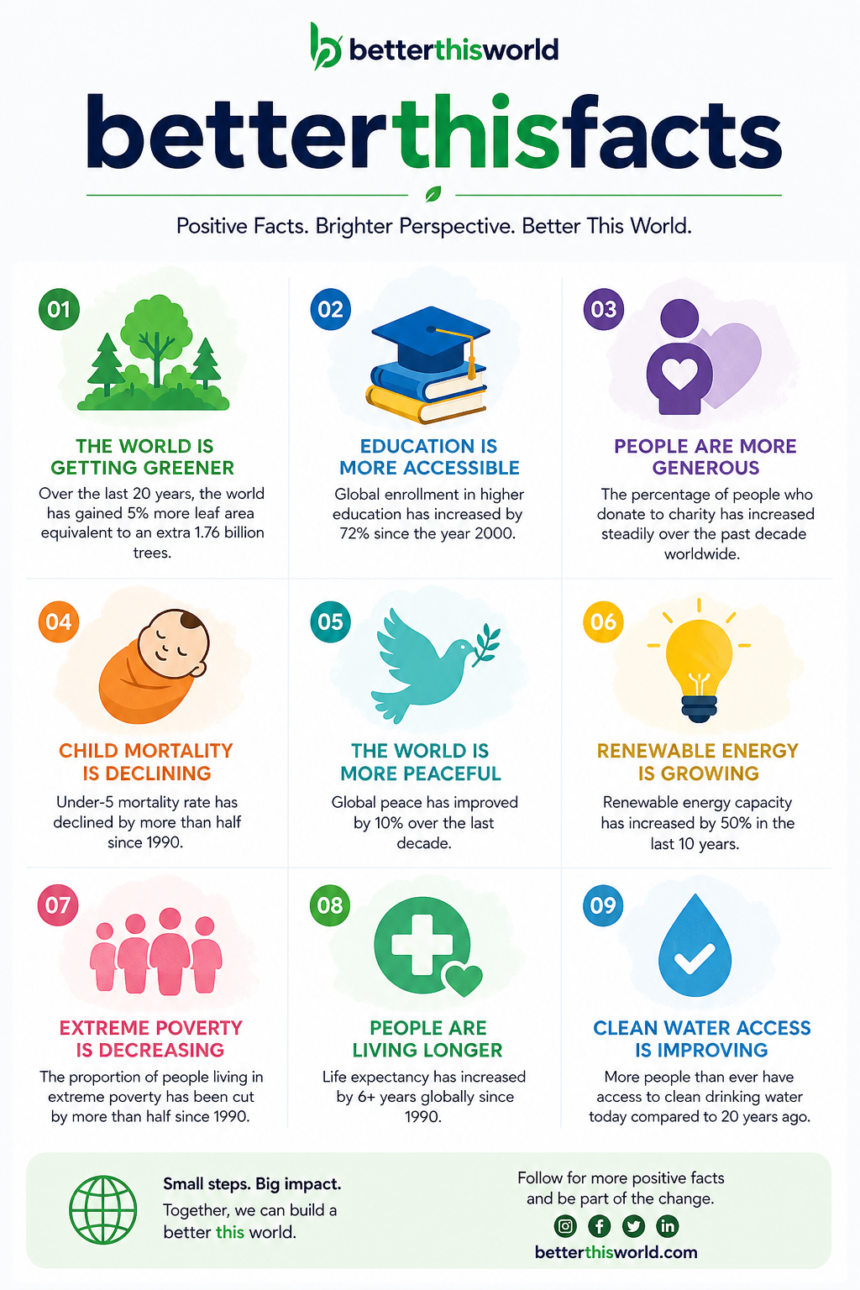
You find a convincing fact online, copy it into a post, and only afterward wonder: where did that claim actually come from? That question matters when exploring betterthisfacts information by betterthisworld. Instead of treating a polished statement as proof by itself, you’ll get much more value by understanding the source behind it, checking supporting evidence, and knowing when independent verification is necessary.
BetterThisFacts appears to be associated with BetterThisWorld in online references, but specific claims about its ownership, editorial process, launch history, or formal status should not be presented as settled without an authoritative source. [unverified — needs source]
That distinction sets the right foundation for understanding the resource.
What Is BetterThisFacts Information by BetterThisWorld?
At a practical level, people searching for betterthisfacts information by betterthisworld are usually looking for fact-focused informational content connected to the BetterThisWorld name. The appeal is straightforward: concise facts can make complex subjects easier to explore.
However, there’s an essential distinction between an informational article and a primary source. A website can provide a useful explanation without being the original authority responsible for the underlying data.
For example, suppose an article states a statistic about U.S. employment. The article itself is a secondary source if the number originally came from the U.S. Bureau of Labor Statistics (BLS). Following the citation to BLS gives you stronger evidence than repeating the secondary article alone.
That’s why the most useful question isn’t simply, “Is BetterThisFacts trustworthy?” Reliability has to be assessed at the level of the specific claim, source, author, and publication date.
Is BetterThisFacts the Same as BetterThisWorld?
The wording of the keyword implies an association between the two names. Searchers may encounter BetterThisFacts as a feature, content label, or property attributed to BetterThisWorld.
The exact organizational relationship should be confirmed using an official BetterThisWorld page, such as an About, author, editorial, or ownership page. Claims that BetterThisFacts is a formally separate publication, subsidiary, or dedicated product would require additional evidence. [unverified — needs source]
That may sound like a small semantic issue, but it matters. Search snippets and third-party websites routinely turn loose associations into definitive claims that the original publisher never made.
Why People Search for BetterThisFacts
Search behavior around an unfamiliar content brand usually begins with one of two questions: “What is this?” and “Can I trust it?”
Readers may be using betterthisfacts information by betterthisworld for quick learning, research inspiration, social content, or to locate explanations of subjects they’ve encountered elsewhere. Short, accessible facts are particularly useful for discovering questions worth investigating further.
The danger comes when discovery is confused with verification. A memorable sentence can be accurate, partially accurate, outdated, or stripped of the context required to interpret it correctly.
Information Discovery vs. Evidence
Think of an informational resource as a starting point.
If BetterThisFacts tells you something you didn’t know, the immediate value may be discovery. If you need to publish, cite, or make a consequential decision based on that information, your next job is verification.
A strong verification chain looks like this:
Claim → cited evidence → original source → publication date → context
If one of those links is missing, you don’t automatically have a false claim. You simply have less evidence supporting it.
How to Evaluate BetterThisFacts Information by BetterThisWorld
You don’t need professional fact-checking software to assess an online claim. A browser, a few reliable sources, and a consistent process will handle many everyday cases.
Step 1: Find the Original Page
Start with the actual page containing the statement rather than a screenshot, social repost, AI-generated summary, or another blog quoting it.
Check the domain and full URL. Look for signs that you’re viewing the publisher’s original material rather than a third-party interpretation.
Search snippets aren’t enough. Google can truncate, combine, or display text without the full context available on the underlying page.
Step 2: Identify the Exact Claim
Extract the sentence you want to verify.
A vague statement such as “exercise is good for mental health” is difficult to test because “good” covers many possible outcomes. A claim involving a specific percentage, population, study result, date, event, or causal relationship is much easier to investigate.
Ask:
- What exactly is being asserted?
- Does the claim contain a number?
- What population does it concern?
- Is a particular time period implied?
- Does it claim correlation or causation?
Step 3: Check the Author and Publication Date
Look for the writer’s name, publication date, update date, and any author biography.
Credentials aren’t a substitute for evidence, but they help you evaluate expertise. A credentialed specialist can still make an unsupported claim, while a general writer can accurately summarize a strong primary source.
Dates matter just as much. Statistics, product details, regulations, scientific consensus, and public records can change.
Step 4: Follow the Citations
When betterthisfacts information by betterthisworld includes an external citation, open it rather than assuming it proves the sentence.
Check whether the cited source really supports the claim. Watch for an article citing one number while the original report measures something slightly different.
Prefer sources closest to the evidence, such as:
- Government agencies for official statistics.
- Peer-reviewed research for scientific findings.
- Universities and established research institutions.
- Original laws, regulations, and court opinions for legal claims.
- Company filings for specific corporate financial information.
- Official documentation for technical specifications.
Step 5: Look for Independent Corroboration
Search the core claim separately.
Two websites repeating the same language don’t necessarily represent two independent sources. They may both have copied a press release, news story, or original article.
Try to find an independent organization that arrived at the information through its own reporting, data, or analysis.
Step 6: Read the Context Around the Number
Statistics can be technically accurate while still creating the wrong impression.
For example, imagine an article says an outcome “increased by 50%.” If the underlying rate moved from 2% to 3%, the relative increase is indeed 50%, but the absolute increase is one percentage point.
Neither number is inherently wrong. The fuller context lets you understand what actually happened.
Step 7: Decide How You’ll Use the Information
Your required evidence standard should match the consequences.
A low-stakes trivia conversation doesn’t require the same documentation as medical advice, financial analysis, academic work, or professional journalism. For high-stakes topics, go beyond BetterThisFacts or any other secondary publisher and consult authoritative primary sources or qualified professionals.
Two Real-World Ways to Verify a Claim
Consider a reader who sees a claim about the size of the world population. Instead of citing a secondary summary, the reader can compare it with the United Nations Department of Economic and Social Affairs’ World Population Prospects data.
That gives the reader an identifiable methodology, reference year, and original institutional source. It also reveals whether a supposedly current number is actually based on an older estimate.
A second example is an article quoting the U.S. unemployment rate. The Bureau of Labor Statistics publishes the Employment Situation report and explains the underlying Current Population Survey methodology.
If a BetterThisFacts article accurately summarizes that number, it can still be useful for discovery. For formal research, however, citing the corresponding BLS release provides the stronger source.
These examples don’t establish whether any particular BetterThisFacts article contains those claims. They demonstrate a verifiable process readers can apply whenever they encounter statistics online.
Can You Trust BetterThisFacts?
There isn’t enough independently verified evidence presented here to issue a blanket reliability rating for every item carrying the BetterThisFacts name.
More importantly, blanket trust scores are poor substitutes for source-level evaluation. Even publications with rigorous editorial standards can make mistakes, while lesser-known sites can accurately quote excellent primary evidence.
When assessing betterthisfacts information by betterthisworld, focus on observable signals:
- Positive signals: named authors, dates, transparent corrections, direct citations, original-source links, clear distinctions between opinion and fact, and evidence that directly supports the text.
- Warning signals: anonymous assertions, missing dates, extraordinary claims without evidence, circular citations, broken source links, misleading headlines, or statistics with no methodology.
Absence of a citation also doesn’t prove a claim false. It means you need to do more work before treating the statement as established evidence.
BetterThisFacts vs. Other Information Sources
The requested comparison with “animeidhen” isn’t applicable to this topic. Animeidhen does not have an established, verifiable role as a comparable source for BetterThisFacts based on the information available here, so inventing a comparison would mislead readers. [unverified — needs source]
A more useful comparison is between the types of sources readers might actually use.
| Source type | Best use | Primary evidence? | Typical strength | Key limitation |
|---|---|---|---|---|
| BetterThisFacts/BetterThisWorld content | Discovery and explanations | Usually needs checking | Accessible presentation | Reliability depends on individual sourcing |
| Government/official sources | Statistics and official records | Often | Direct authority and methodology | Can be technical |
| Peer-reviewed research | Scientific questions | Often original research | Methods and evidence are documented | Individual studies aren’t automatically consensus |
| Encyclopedic/reference sources | Background and orientation | Usually no | Broad context and citations | Shouldn’t replace original evidence when stakes are high |
The right choice isn’t always one source over another. Often, a secondary article helps you understand the subject while its primary sources provide the evidence you ultimately cite.
Pros and Cons of Using BetterThisFacts
A balanced assessment requires separating the format’s potential benefits from claims about the publisher that cannot currently be verified.
Pros
- Fact-oriented material can make unfamiliar topics easier to explore.
- Concise explanations can help readers identify subjects for deeper research.
- External citations, when present and relevant, give readers a path toward original evidence.
- The BetterThisWorld association may help users find related informational material in one place. [specific relationship unverified — needs source]
Cons
- A secondary article isn’t automatically an authoritative source.
- Unsupported claims require independent verification.
- Older pages can contain facts that were correct at publication but have since changed.
- The editorial and fact-checking process should not be assumed unless the publisher documents it.
- Search results about BetterThisFacts may themselves contain unsupported descriptions of the brand.
How to Fact-Check BetterThisFacts in Under Five Minutes
For an everyday claim, you can compress the longer process into a quick routine.
- Copy the central factual statement.
- Record the page URL, author, and publication or update date.
- Open any source cited next to the statement.
- Confirm that the source says what the article claims it says.
- Search the claim using distinctive terms or the exact statistic.
- Prioritize government, academic, scientific, or other relevant primary sources.
- Compare the date, population, definitions, and context.
- If reliable sources disagree, don’t present the disputed claim as settled.
For topics such as health or finance, five minutes may not be enough. The shortcut is useful for triage, not a replacement for careful research when decisions carry meaningful consequences.
Common Mistakes When Evaluating Online Facts
One of the biggest mistakes is treating Google ranking as proof of accuracy. Search engines rank pages using many signals, but a high position isn’t an independent certification that every sentence on the page is true.
Another problem is citation laundering. Website A cites Website B, which cites Website C, which ultimately refers back to A—or to no identifiable original evidence at all.
AI summaries create an additional verification challenge. Generative systems can provide useful orientation, but they can also misattribute claims, merge sources, or produce citations that don’t support the generated sentence. Check the underlying source regardless of whether you discovered a BetterThisFacts claim through an AI assistant, social network, or search engine.
E-E-A-T and BetterThisFacts
Google’s concepts of experience, expertise, authoritativeness, and trust are useful as an editorial framework, although publishers shouldn’t treat E-E-A-T as a simplistic numerical score.
Google’s Search Quality Rater Guidelines emphasize trust and consideration of who created content, how it was produced, and its purpose. Google Search Central also recommends creating helpful, reliable, people-first content rather than content made primarily to manipulate rankings.
For betterthisfacts information by betterthisworld, readers can apply similar questions:
- Who wrote this?
- What evidence supports it?
- Does the author have relevant expertise or experience?
- Is the source transparent about its purpose?
- Can the factual statements be independently reproduced or verified?
- Does the page correct or update outdated information?
The final question matters because reliability is a process, not merely a brand attribute.
Primary Sources Worth Knowing
The correct primary source depends entirely on the subject. For U.S. economic numbers, sources such as the Bureau of Labor Statistics or Bureau of Economic Analysis may be appropriate; for population data, agencies such as the U.S. Census Bureau and international bodies such as the United Nations can be relevant.
For health research, PubMed can help locate scientific literature, though being indexed in a database doesn’t make every conclusion definitive. For U.S. law, legislation, regulations, and court documents often offer stronger evidence than a third-party summary.
Wikipedia and general blogs can be useful for discovering terminology and references. They shouldn’t automatically be treated as the final evidentiary source for consequential claims.
Internal Linking Opportunities
Publishers building a topic cluster around this article could add internal links using:
- how to fact-check information online
- how to identify credible sources
- primary vs. secondary sources explained
- how to spot misinformation
- Google E-E-A-T guidelines explained
Those supporting pages would satisfy adjacent reader questions without forcing this article to become an exhaustive guide to every aspect of media literacy.
Conclusion
BetterThisFacts can be approached the same way you’d approach any fact-oriented web resource: use it to discover information, then assess individual claims by examining authorship, dates, citations, context, and primary evidence. The name of a publisher alone can’t guarantee accuracy.
The strongest habit is simple: don’t ask only whether a website is trustworthy; ask whether the evidence supporting the specific statement is trustworthy. Until authoritative documentation establishes details such as BetterThisFacts’ exact organizational structure and editorial methodology, those details should remain qualified rather than repeated as fact.
If you’ve landed here after searching for betterthisfacts information by betterthisworld, start with the original content, follow its sources, and independently verify any claim you plan to cite or act upon. That gives you something much more useful than a blanket verdict: a repeatable way to determine whether the information in front of you deserves confidence.