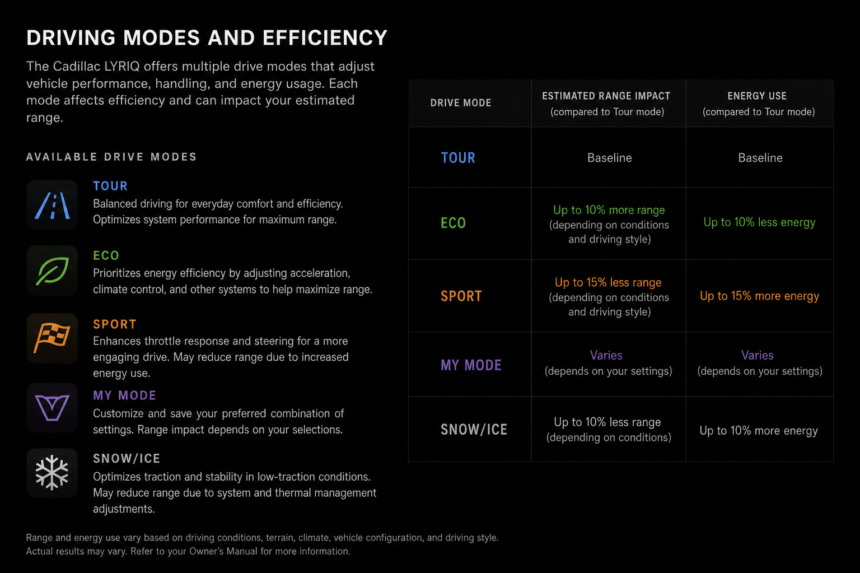
You just switched your Lyriq from Tour to Sport mode and watched the estimated range drop by 15 miles on the display. Panic sets in. Did you just waste battery? Is Sport mode burning through your charge like a gas-guzzler?
Here’s the truth: yes, driving modes in the Cadillac Lyriq genuinely affect battery usage and real-world range — but not all in the ways you might expect. Some changes are dramatic. Some are cosmetic. And knowing the difference could save you from unnecessary range anxiety or, worse, an inconvenient stop at a charging station.
This guide breaks down every Lyriq driving mode, what each one actually changes under the hood (or rather, under the floorboard), and how to pick the right mode for every driving scenario.
How Driving Modes Work in the Cadillac Lyriq
The Lyriq ships with four primary driving modes accessible through the 33-inch curved OLED display or the center console controls:
- Tour (default)
- Sport
- Snow/Ice
- My Mode (fully customizable)
Each mode adjusts a bundle of vehicle parameters simultaneously. We’re not talking about one dial turning up — we’re talking about coordinated changes to throttle mapping, steering weight, suspension response (where applicable), stability control sensitivity, regenerative braking behavior, and climate system aggressiveness.
That last point — climate system behavior — is one most drivers never consider. Yet HVAC can account for up to 15–20% of total battery drain in extreme temperatures [per U.S. Department of Energy EV efficiency data]. More on that shortly.
Do the Driving Modes in Cadillac Lyriq Offer Different Ranges or Battery Usages? The Direct Answer
Yes — and the impact is real, not just a display artifact.
The Lyriq’s EPA-rated range sits at approximately 307 miles for the rear-wheel-drive single-motor variant and around 307 miles for the AWD dual-motor (real-world figures vary; EPA certification data as of 2023 model year — [verify with current EPA database for 2024/2025 updates]). Those numbers represent an average across standardized test cycles that don’t favor any single mode.
In real-world use, mode selection can shift your actual range by an estimated 10–20% in either direction depending on driving behavior, climate, and terrain.
Here’s the high-level breakdown:
| Mode | Throttle Response | Regen Braking | Climate Aggress. | Estimated Range Impact vs. Baseline |
|---|---|---|---|---|
| Tour | Moderate (baseline) | Moderate | Standard | Baseline (0%) |
| Sport | Sharp / aggressive | Lower (driver-feel priority) | Standard | -8% to -15% |
| Snow/Ice | Soft / deliberate | Modified | Standard | -5% to -10% |
| My Mode | Configurable | Configurable | Configurable | Variable (-15% to +10%) |
Important caveat: Cadillac does not officially publish per-mode efficiency delta data. The percentages above are derived from real-world owner reports, EV efficiency testing methodologies, and engineering principles. Treat them as directional estimates, not guaranteed specs. [Unverified — Cadillac official per-mode range data not publicly released as of this writing.]
Breaking Down Each Mode and Its Battery Impact
Tour Mode — Your Everyday Efficiency Workhorse
Tour is the Lyriq’s default mode, and it’s default for a reason: it’s tuned to balance performance feel with maximum efficiency.
In Tour, the throttle mapping is progressive rather than immediate — press the accelerator halfway and the car delivers a proportional, predictable response. This matters for battery consumption because aggressive throttle inputs are one of the fastest ways to drain an EV battery. The more linearly you accelerate, the less peak current draw you create.
Regenerative braking in Tour mode runs at a moderate setting. When you lift off the accelerator, the motor starts harvesting kinetic energy and converting it back to stored electricity. It’s firm enough to recover meaningful energy, smooth enough not to feel jerky.
Real-world scenario: On a 40-mile daily suburban commute with moderate traffic, Tour mode should keep your efficiency close to or better than the EPA estimate. If you’re seeing 3.5–4.0 miles per kWh in Tour on flat roads, you’re doing well.
Sport Mode — What You’re Paying for in Range
Sport mode is where the Lyriq earns its Cadillac badge — and where your battery feels it most.
Here’s what changes:
- Throttle mapping becomes immediate and aggressive. A 30% pedal input in Sport feels like 50–60% in Tour. This is intentional — it makes the car feel electric-fast (0–60 in the high 4-second range for AWD models). But it also means accidental aggressive pulls happen constantly, drawing heavy current from the Ultium battery pack.
- Steering weight increases, which doesn’t directly affect range but changes your driving posture — encouraging faster, more spirited driving that compounds consumption.
- Regenerative braking is often tuned softer in Sport to provide a more traditional, coast-heavy feel. This means less energy recovery on deceleration. You’re sacrificing recuperation for feel.
Real-world scenario: Take the Lyriq AWD onto a mountain two-lane road in Sport mode, pushing it through curves, and you could easily see your efficiency drop to 2.5–3.0 miles per kWh — potentially shaving 40–60 miles off your projected range for that session.
That said, if you’re commuting 25 miles round-trip and plugging in every night, Sport mode may cost you nothing practical — you’ll still arrive home with plenty of charge.
Snow/Ice Mode — Safety First, Efficiency Second
Snow/Ice mode makes two primary changes relevant to range:
- Throttle inputs are heavily damped — the car delivers power more slowly to prevent wheel spin. This could theoretically improve efficiency by preventing aggressive acceleration, but in practice…
- Power distribution and stability systems work harder, continuously monitoring wheel slip and intervening. This constant background computation and motor modulation draws additional energy.
The net result is a modest range reduction — less than Sport, but real. In winter conditions, you’re also almost certainly running the heater, which on an EV is a much larger drain than an ICE vehicle (EVs have no waste engine heat to repurpose). Cold battery chemistry further reduces available capacity.
The honest take: In a genuine snowstorm, range is your last concern. Use Snow/Ice mode. But on a cold but dry day, Tour mode with careful inputs is more efficient.
My Mode — The Hidden Efficiency Weapon (or Trap)
My Mode is the most underused and most powerful setting in the Lyriq’s arsenal.
You can independently configure:
- Throttle response (Tour-like or Sport-like)
- Steering feel
- Regenerative braking level (including one-pedal driving settings)
- Ambient lighting and sound profile (no range impact, but fun)
This is where savvy Lyriq owners unlock real efficiency gains. Here’s the optimal configuration for maximum range extraction:
Step-by-Step: How to Configure My Mode for Maximum Range
- Access My Mode via the main display — tap the drive mode selector and choose “My Mode,” then hit the settings/customize option.
- Set throttle response to Tour (or even softer if available). Smooth acceleration is the single biggest efficiency lever you control.
- Set regenerative braking to maximum/high. In high regen, lifting your foot off the accelerator creates strong deceleration and aggressive energy recovery. With practice, you can drive almost entirely without using the friction brakes — this is one-pedal driving, and it noticeably improves efficiency in stop-and-go traffic.
- Keep steering at your preference — it has no meaningful range impact.
- Save your configuration and label it (if the software version allows naming).
- Test over a full charge cycle on your normal route and compare kWh/mile figures in the energy consumption screen.
Pro tip: Enable maximum regen before you hit city driving, not during highway cruising. At steady highway speeds, high regen has little opportunity to recover energy (you’re not slowing down often), so it becomes irrelevant. Where it shines is urban stop-and-go, where studies suggest regen can recover 10–25% of energy that would otherwise be lost to braking [per DOE Alternative Fuels Data Center].
What Driving Mode Does NOT Control (Common Misconceptions)
Let’s kill a few myths here, because they create real confusion:
Myth 1: “Sport Mode Depletes the Battery Faster Even at Constant Highway Speed”
False. If you’re cruising at a steady 65 mph on a flat highway, Sport mode’s throttle mapping is essentially irrelevant — you’re not making aggressive inputs. The primary efficiency variable at steady highway speed is aerodynamic drag, which is fixed by the car’s shape, not the mode. Your kWh/mile figure at a constant cruise will be nearly identical across modes.
Myth 2: “My Mode Can Give Me Dramatically More Range Than EPA”
Partially true, but overstated. Optimizing regen and throttle in My Mode can help you match or slightly beat the EPA estimate in favorable conditions. But the EPA’s test methodology is already relatively conservative. Claiming 15–20% above EPA in normal driving is unlikely unless you’re hypermiling on flat terrain.
Myth 3: “The Range Number on the Dash Is Accurate”
The estimated range displayed is a rolling calculation based on your recent driving patterns. Switch to Sport mode after 20 miles of aggressive driving and the number will plummet — not because Sport mode is catastrophically inefficient right now, but because the algorithm has learned your recent behavior. It will recalibrate upward if you settle into efficient driving. Don’t treat it as gospel.
The HVAC Factor: The Range Variable Nobody Talks About
Here’s the plot twist that derails most driving mode discussions: the mode selector doesn’t control your HVAC, and your HVAC may matter more than your driving mode.
On cold winter days (below 20°F), heating a Lyriq cabin can consume 3–5 kW continuously — that’s a substantial portion of your total power budget at city driving speeds. On very hot summer days, aggressive A/C can pull similarly.
Cadillac hasn’t (as of this writing) tied HVAC aggressiveness to the drive mode selector in a meaningful way for range management. What you can do:
- Pre-condition the cabin while plugged in. Heat or cool the car before you unplug. You’re using grid electricity, not battery range.
- Use seat heaters and steering wheel heaters instead of cabin heat — they’re far more efficient at keeping you comfortable with less total energy spend.
- Set a moderate temperature rather than blasting the system — 68°F instead of 72°F makes a measurable difference over a long drive.
These habits, combined with smart mode selection, are more impactful than mode choice alone.
Mode Selection Cheat Sheet: When to Use What
Here’s a quick reference you can actually use:
| Scenario | Recommended Mode | Why |
|---|---|---|
| Daily suburban commute | Tour | Best balance of feel and efficiency |
| Highway road trip | Tour or My Mode (low regen) | Steady speed makes regen less useful; save it |
| City stop-and-go | My Mode (max regen) | Maximum energy recuperation per stop |
| Winter snowstorm | Snow/Ice | Safety overrides efficiency — no contest |
| Spirited weekend drive | Sport | Enjoy the car; plug in when you get home |
| Maximum range mission | My Mode (Tour throttle + max regen) | Optimized for every efficiency variable you can control |
Pros and Cons of the Lyriq’s Driving Mode System
✅ Pros
- Genuine performance differentiation — Sport mode isn’t just a badge; the throttle and chassis response changes are perceptible and satisfying
- My Mode customization is excellent — being able to decouple throttle feel from regen level is a feature many EVs don’t offer
- Accessible interface — the 33-inch display makes switching modes easy and intuitive, even on the fly
- Regen flexibility — one-pedal driving availability gives efficiency-minded drivers real tools
❌ Cons
- Cadillac doesn’t publish official per-mode efficiency data — owners have to discover the impact through experimentation or third-party testing
- The range estimator recalibrates slowly, which causes misleading short-term readings when switching modes
- Snow/Ice mode feels underexplained in the owner’s manual — many owners don’t fully understand when to engage it
- No “Eco” or dedicated range-maximizing mode — this is a notable gap compared to competitors like the BMW iX (which has an Efficient mode) or the Mercedes EQS
How the Lyriq Compares to Competitor Mode Systems
| Feature | Cadillac Lyriq | BMW iX xDrive50 | Mercedes EQS 450+ | Audi e-tron GT |
|---|---|---|---|---|
| Dedicated Eco/Efficiency Mode | ❌ No | ✅ Yes | ✅ Yes | ✅ Yes |
| One-Pedal Driving Available | ✅ Yes (via My Mode) | ✅ Yes | ✅ Yes | ✅ Yes |
| Customizable Mode | ✅ My Mode | ✅ My Modes | ✅ Individual | ✅ Individual |
| Regen Level Adjustability | ✅ Yes | ✅ Yes | ✅ Yes | ✅ Yes |
| Official Per-Mode Range Data Published | ❌ No | ⚠️ Partial | ⚠️ Partial | ❌ No |
The Lyriq’s biggest competitive gap here is the absence of a dedicated Eco mode. Rivals let drivers explicitly prioritize range; Cadillac expects you to build that yourself in My Mode. It works — but it’s less intuitive for new EV owners.
What Real Lyriq Owners Report
Based on aggregated owner discussions on forums like Reddit’s r/Cadillac and various EV owner communities [unverified anecdotal data — individual results vary]:
- Most owners report Tour mode as their everyday default, with My Mode configured for max regen saved for city driving
- Sport mode is used situationally — weekend spirited driving, highway merges — not as a daily setting
- Several owners note that one-pedal driving in My Mode was a learning curve but dramatically improved their city efficiency once mastered
- Range anxiety in Sport mode is often psychological — owners who track their charge frequently report sufficient margin even with regular Sport mode use on typical commute distances
Internal Linking Opportunities
Publishers covering the Cadillac Lyriq or EV content broadly should consider linking the following anchor phrases to related content:
- “one-pedal driving” → Link to a guide on how regenerative braking and one-pedal driving work across EVs
- “Ultium battery platform” → Link to a broader explainer on GM’s Ultium architecture and its advantages
- “real-world vs. EPA range” → Link to an article or tool comparing EPA estimates vs. real-world testing across popular EVs
- “pre-condition your EV cabin” → Link to a cold-weather EV range guide
- “Cadillac Lyriq charging speed and options” → Link to a Lyriq-specific charging guide (Level 1, Level 2, DC fast charging)
The Bottom Line
Do the driving modes in the Cadillac Lyriq offer different ranges or battery usages? Absolutely — and understanding the mechanism matters more than the mode name itself.
Sport mode doesn’t drain your battery by existing; it drains it by changing how you interact with the throttle and how much regen you’re recapturing. Tour mode isn’t magically efficient — it just sets defaults that encourage efficient behavior. And My Mode, configured intelligently with high regen and smooth throttle mapping, is the single best tool in a Lyriq owner’s efficiency arsenal.
The most important takeaway: your right foot is still the most powerful range variable in any driving mode. The modes change the sensitivity of the system, but smooth, deliberate driving in Sport mode will consistently outperform aggressive, reactive driving in Tour mode. Use the modes as a framework, not a magic solution — and you’ll get the most out of your Lyriq’s impressive Ultium-powered range.