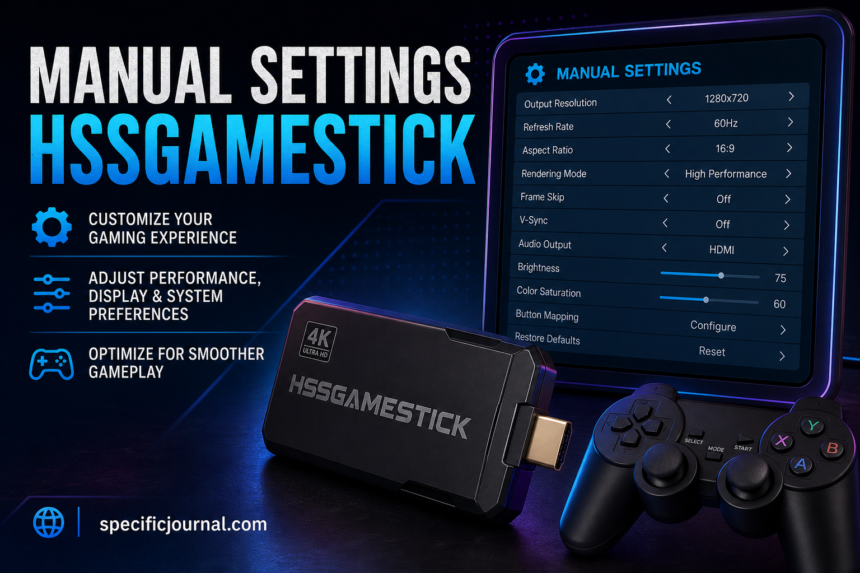
If you’re searching for manual settings HSSGameStick, you’re probably trying to do one simple thing: make your game stick work better with your TV, controller, and preferred games.
The term is used online for guides covering HSSGameStick configuration, including display, controller, audio, and gameplay options. However, there is an important detail to understand first: settings can vary between HSSGameStick versions, so you shouldn’t assume that every menu or option mentioned online exists on your particular device.
The available HSSGameStick website describes its purpose as providing gaming-stick setup guides, instructions, and information about settings. Its published guides discuss display adjustments, controller mapping, sensitivity, and troubleshooting.
What Does “Manual Settings HSSGameStick” Mean?
“Manual settings HSSGameStick” generally refers to changing the device’s configuration yourself instead of relying entirely on default options.
Depending on the version of the device or software, this can include:
- Display resolution
- Aspect ratio
- Controller button mapping
- Controller sensitivity
- Audio output
- Emulator settings
- Game-specific configurations
- Other system preferences
The exact options shouldn’t be treated as universal. Current search results show different guides describing different menus and capabilities, which suggests that HSSGameStick configurations may not all use the same software or hardware.
For example, the HSSGameStick site’s own instructions mention 720p and 1080p display options, aspect-ratio controls, button mapping, sensitivity, emulator-related settings, and game profiles.
Read More: General News LogicalShout: What It Actually Means and What the Site Covers
How to Find the Manual Settings
The exact menu path depends on the version you have.
A commonly described process is:
- Turn on the HSSGameStick.
- Wait for the main game menu to load.
- Open the main menu or settings area using the controller.
- Look for options such as Settings, System Settings, Display, Controller, or Game Settings.
- Change one setting at a time.
- Save the configuration if your version provides a save option.
- Test a game before making additional changes.
One HSSGameStick guide describes opening the main dashboard and selecting settings before switching from default to manual configuration.
If your menus don’t match these names, don’t force the instructions. Different versions may organize their settings differently.
Display and Resolution Settings
Display settings are usually the first place to check when the picture looks stretched, blurry, or doesn’t appear correctly on your TV.
The HSSGameStick instructions currently available online specifically mention 720p and 1080p resolution choices, along with aspect-ratio adjustments.
Choosing the Resolution
If your device offers multiple resolutions, start with the setting that is appropriate for your television or monitor.
For example:
- 720p: Useful when your display or configuration works better at a lower resolution.
- 1080p: Appropriate when supported by both the device and display and you want a higher-output resolution.
Don’t assume that selecting the highest available number automatically makes an old game look sharper. Retro games can still have low-resolution original graphics, and upscaling doesn’t recreate detail that wasn’t present in the original image.
Fixing a Stretched Picture
If the game looks unusually wide or distorted, check the aspect ratio.
Retro games were often designed around older display formats. A widescreen setting can stretch some older games across a modern television.
If your HSSGameStick provides multiple aspect-ratio options, test them with an older game and choose the one that preserves the image shape you prefer.
Controller and Button Settings
Controller configuration is another major reason people look for manual HSSGameStick settings.
The available HSSGameStick instructions describe button mapping and sensitivity adjustments, including the ability to configure different control layouts for different emulators.
Button Mapping
Button mapping lets you change which physical controller button performs a particular action.
A basic approach is:
- Open the controller or input settings.
- Select the controller configuration.
- Choose the button you want to change.
- Assign the desired function.
- Save the configuration.
- Test it in a game.
Be careful when changing several buttons at once. If the layout becomes confusing, restoring the original configuration may be easier than trying to remember every previous assignment.
Sensitivity
Some HSSGameStick guides refer to sensitivity controls, but the meaning of sensitivity depends on the controller and emulator.
If your version provides sensitivity options, make small adjustments rather than moving immediately to an extreme value.
A useful approach is to:
- Start with the default.
- Make one small change.
- Test the controller.
- Compare the result with the previous setting.
- Keep the change only if it actually improves control.
There is no single sensitivity value that is automatically correct for every game.
Emulator Settings
Some HSSGameStick documentation discusses emulator-specific configuration.
The published instructions mention features such as:
- Emulator-core switching
- Scanline effects
- Shaders
- Different control layouts for emulators
These options can matter because different generations of games were designed around different hardware and display characteristics.
Should You Change the Emulator Core?
Only do this when you have a reason.
If a game already runs correctly, changing emulator settings simply for the sake of experimentation can create another problem without solving the original one.
If a particular game fails to load or behaves incorrectly, check whether your HSSGameStick version provides another compatible emulator or core. The available instructions specifically mention trying another core as one possible troubleshooting step for games that won’t load.
Audio Settings
Audio problems can sometimes be caused by the configuration rather than the game itself.
If you have picture but no sound, check:
- TV volume
- Mute status
- HSSGameStick audio options
- TV audio input
- Available audio-output modes
One HSSGameStick guide recommends checking the output mode when there is no audio and switching modes if necessary.
Don’t change several audio options simultaneously. Change one setting, test it, and then move to the next if necessary.
How to Handle Lag or Slow Gameplay
Changing manual settings can help diagnose performance problems, but it’s important not to assume that every form of lag is caused by graphics settings.
Start with the basics.
If Games Feel Slow
Try:
- Restarting the HSSGameStick.
- Checking the HDMI connection.
- Checking the power connection.
- Reducing demanding display options if your version provides them.
- Testing another game.
- Returning recently changed settings to their previous values.
The HSSGameStick guides commonly associate performance problems with configuration choices such as resolution or frame-rate behavior.
However, a slow game can also be caused by the particular emulator, game, controller connection, power supply, or hardware version. Manual settings aren’t a guaranteed solution.
Common HSSGameStick Problems and What to Check
| Problem | First things to check |
|---|---|
| No picture | HDMI connection, correct TV input, power |
| Black screen | Resolution and HDMI connection |
| No sound | TV volume, mute status, audio-output settings |
| Controller not responding | Batteries, receiver, pairing, controller settings |
| Game won’t load | Restart, game configuration, available emulator/core |
| Picture looks stretched | Aspect ratio |
| Controls feel wrong | Button mapping and sensitivity |
| Gameplay feels slow | Restart, display settings, power and emulator configuration |
These are troubleshooting starting points rather than guaranteed fixes. The published HSSGameStick instructions also recommend checking resolution for black-screen problems, audio mode for missing sound, and controller batteries when input isn’t working.
A Safer Way to Change Manual Settings
The easiest mistake to make with configuration is changing too many things at once.
Instead, use this process:
1. Start With the Defaults
Before making changes, understand how the device currently behaves.
2. Change One Setting
For example, change the resolution without changing the controller or audio settings.
3. Test It
Play a game for a few minutes.
4. Keep or Revert the Change
If the change helped, keep it. If it didn’t, return to the previous setting.
5. Move to the Next Setting
This makes troubleshooting much easier because you know which change caused a particular result.
If your version provides multiple profiles or saved configurations, use them where appropriate. The HSSGameStick instructions claim that some configurations support several user profiles, but this should be confirmed against the particular version of your device.
Why Online HSSGameStick Guides Can Conflict
This is one of the most important things to understand when researching manual settings HSSGameStick.
Current search results contain several websites describing the device, but their descriptions aren’t completely consistent.
Some pages describe HSSGameStick as a simple HDMI retro-gaming device. Others mention Android, RetroArch, EmuELEC, advanced controller settings, or features that aren’t documented on the main HSSGameStick site.
That means you should be cautious with guides that give highly specific technical numbers or claim that a particular menu exists on every HSSGameStick.
For example, a third-party page currently provides specific polling rates, dead-zone values, firmware claims, and command-line instructions. Those details aren’t independently established by the primary HSSGameStick material found in the current search results, so they shouldn’t be treated as universal HSSGameStick instructions.
What to Do Before Using Advanced Settings
Before following a detailed configuration guide, identify your exact device version.
Check:
- The name printed on the device
- Packaging
- Included controller
- Main-menu appearance
- Settings-menu names
- Available resolution options
- Any model or version number shown in system information
This matters because a setting from one version may not exist on another.
It’s also a good reason to avoid blindly following instructions that tell you to modify firmware, system files, configuration files, or storage media unless you have confirmed that those instructions apply to your exact model.
Frequently Asked Questions
Q: What are manual settings on HSSGameStick?
A: They are configurable options that let you adjust aspects of the device, such as display output, controller mapping, sensitivity, audio, and emulator behavior. The exact options vary by version.
Q: Can I change the HSSGameStick resolution?
A: Available HSSGameStick instructions describe 720p and 1080p options. Your particular device may offer different choices, so check its display menu before changing the setting.
Q: Can I remap the controller buttons?
A: Published HSSGameStick instructions describe button mapping and controller-layout customization. The available controls can differ between games or emulator configurations.
Q: Why does my HSSGameStick look stretched?
A: Check the aspect-ratio setting. Older games may have been designed for different display proportions, and a widescreen mode can make the image appear stretched.
Q: Why isn’t my controller responding?
A: Start with the simple checks: replace or recharge the batteries if applicable, confirm the receiver is connected, restart the device, and check the controller configuration. The published HSSGameStick instructions specifically identify controller batteries as one possible cause.
Q: Is there one set of manual settings that works for every HSSGameStick?
A: Not reliably. Online documentation describes different hardware and software configurations, so settings should be matched to your specific version rather than copied blindly from another guide.
Final Thoughts
Manual settings HSSGameStick are most useful when you treat them as a way to solve a specific problem rather than a collection of numbers you need to copy.
Start with the display, controller, and audio settings that are actually available on your device. Make one change at a time, test it, and keep a note of the original configuration.
Most importantly, don’t assume that every setting described online belongs to every HSSGameStick. The current documentation is not completely consistent across the web, so model-specific information should take priority over generic configuration advice.