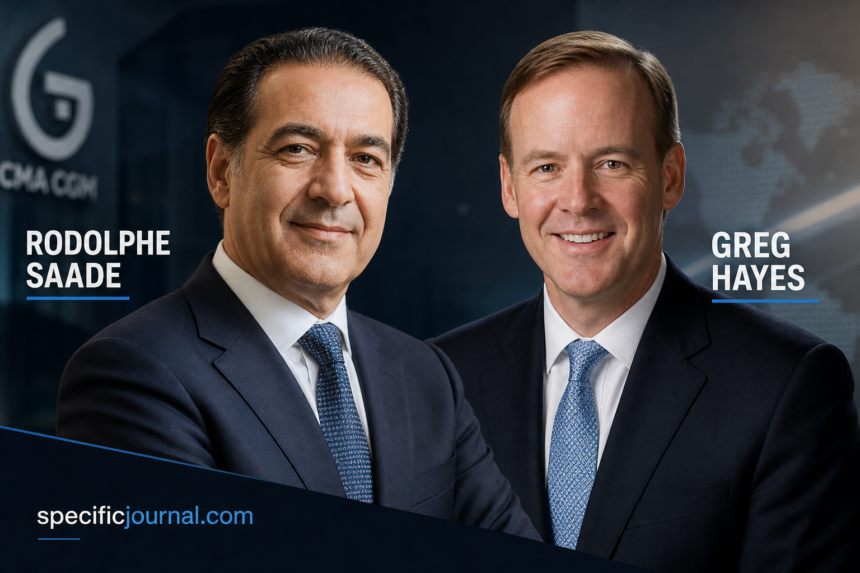
What connects Rodolphe Saadé and Greg Hayes? Are the two executives business partners, or do their names appear together because of their influence over major international industries?
The distinction matters. Saadé leads CMA CGM, a global shipping and logistics group, while Hayes built his career in aerospace and defense through United Technologies and RTX. Their professional backgrounds offer an interesting comparison, but publicly available corporate information does not establish a direct business partnership between them.
Understanding their careers reveals two different approaches to corporate leadership: expanding a transportation business across multiple markets and reshaping an industrial company around aerospace.
Rodolphe Saadé and Greg Hayes: Is There a Direct Business Connection?
There is no verified public evidence establishing a significant direct partnership, joint venture, or shared corporate role between Rodolphe Saadé and Greg Hayes.
Their names can be discussed together because both have held senior positions in large international businesses. However, working in related economic sectors does not automatically mean two executives have collaborated.
Their main professional differences are clear:
- Rodolphe Saadé: Shipping, logistics, air cargo, and international trade.
- Greg Hayes: Aerospace, industrial management, corporate restructuring, and defense.
- Shared business context: Both have operated in industries that depend on complex supply chains, international markets, and long-term investment.
The more useful question, therefore, is how each executive built his career and influenced the companies he led.
Rodolphe Saadé: Expanding CMA CGM Beyond Shipping
Rodolphe Saadé was born in Lebanon in 1970 and studied business and marketing at Concordia University in Montreal. He joined CMA CGM in 1994 after starting a water-dispenser business.
Over the following years, he took on responsibilities across the company’s shipping operations and international routes. He became chairman and chief executive officer of CMA CGM in November 2017, according to the company’s official executive biography.
How CMA CGM developed under Saadé
Saadé’s leadership has focused on expanding the company’s reach beyond traditional container shipping.
Several important developments illustrate that strategy:
- CEVA Logistics: CMA CGM completed its public tender offer for CEVA Logistics in 2019, strengthening its position in freight forwarding and contract logistics.
- Air cargo: The group established CMA CGM AIR CARGO in 2021, extending its transportation services into air freight.
- Logistics expansion: Acquisitions and investments have broadened its involvement in warehousing, e-commerce logistics, and related transportation services.
This approach gives CMA CGM a wider role in the movement of goods. Instead of focusing exclusively on ocean freight, the company can serve customers across several stages of the supply chain.
For businesses managing international shipments, that broader network can offer more integrated transportation and logistics options.
Greg Hayes: The Executive Behind a Major Aerospace Transformation
Gregory J. Hayes, widely known as Greg Hayes, followed a different route to corporate leadership. He spent much of his career at United Technologies Corporation (UTC), rising through senior finance and management positions before becoming its chief executive in 2014.
Hayes later led RTX, the aerospace and defense company formed through the combination of Raytheon and UTC’s remaining aerospace businesses in 2020.
The corporate decisions that defined his career
Hayes’s tenure involved significant changes to the structure of United Technologies.
Key developments included:
- 2015: UTC sold Sikorsky Aircraft.
- 2018: UTC completed its acquisition of Rockwell Collins.
- 2020: Otis and Carrier became independent companies.
- 2020: UTC’s remaining aerospace businesses combined with Raytheon to form Raytheon Technologies, later renamed RTX.
These decisions helped concentrate the company’s activities around aerospace and defense rather than maintaining its previous mix of industrial businesses.
Hayes stepped down as RTX executive chairman and a board member on April 30, 2025. He subsequently served as a special adviser to the CEO through January 2, 2026, according to RTX’s leadership announcement.
He is no longer RTX’s chief executive. Christopher Calio succeeded him as CEO in May 2024.
What Is Greg Hayes Doing Now?
Hayes remains active in corporate governance.
On May 13, 2026, Phillips 66 appointed him Lead Independent Director. The company also identifies him as chair of its Nominating and Governance Committee and a member of other board committees.
He serves on the board of Becton, Dickinson and Company, commonly known as BD, as well.
These responsibilities mark a shift from running a major aerospace business to overseeing corporate strategy, governance, and executive accountability at other companies.
Phillips 66’s official announcement confirms his appointment and current board role.
Comparing Their Business Strategies
Although both executives have managed complex organizations, their careers reflect different strategic priorities.
| Business area | Rodolphe Saadé | Greg Hayes |
|---|---|---|
| Best known for | Leading CMA CGM | Leading UTC and RTX |
| Core industry | Shipping and logistics | Aerospace and defense |
| Strategic focus | Expanding across the supply chain | Restructuring and consolidating aerospace businesses |
| Major corporate development | CEVA Logistics acquisition | Formation of RTX |
| Current position | Chairman and CEO of CMA CGM | Lead Independent Director at Phillips 66 |
| Verified direct partnership | Not publicly established | Not publicly established |
Saadé’s approach has involved adding transportation and logistics capabilities around CMA CGM’s shipping operations. Hayes’s approach centered on reshaping an industrial portfolio and bringing aerospace businesses together.
Both strategies required decisions about acquisitions, investment, operations, and long-term competitiveness. Their similarities end there unless further evidence establishes a more specific connection.
Why Their Industries Still Matter Together
Shipping and aerospace may appear to serve different purposes, but both are important to international commerce.
CMA CGM helps move consumer goods, industrial materials, and other cargo through maritime, land, and air networks. Aerospace companies such as RTX develop aircraft engines, aviation systems, and defense technologies.
These industries operate within a broader network of manufacturers, suppliers, transport providers, and international customers. Their activities can intersect economically without their executives working together directly.
That is the key distinction when researching Rodolphe Saadé and Greg Hayes: an overlap between industries is not proof of a personal relationship, investment, or business agreement.
Frequently Asked Questions
Are Rodolphe Saadé and Greg Hayes business partners?
No verified public information establishes them as direct business partners. Their careers are associated with different companies and industries.
What company does Rodolphe Saadé lead?
Saadé is chairman and CEO of CMA CGM Group, which operates across container shipping, logistics, air cargo, and related transportation services.
Was Greg Hayes the CEO of RTX?
Yes. Hayes led RTX after its formation in 2020, having previously served as CEO of United Technologies. Christopher Calio became RTX CEO in May 2024.
What does Greg Hayes do in 2026?
Hayes serves as Lead Independent Director of Phillips 66 and sits on the board of Becton, Dickinson and Company. His advisory role at RTX ended in January 2026.
The Bottom Line
Rodolphe Saadé and Greg Hayes have built influential careers, but in different parts of the global economy. Saadé has expanded CMA CGM into a broader shipping and logistics group, while Hayes helped reshape United Technologies and establish RTX as a major aerospace and defense company.
As of October 20, 2026, publicly available corporate records do not establish a direct business partnership between the two men. Their careers are worth comparing for what they reveal about international business leadership, but any stronger claim about a personal or commercial connection would require additional evidence.