If you searched for software automation wbsoftwarement, you may be trying to figure out whether this is a specific automation tool, a software platform, or simply a phrase connected with the website wbsoftwarement.com.
The distinction matters. Current search results show that wbsoftwarement.com has a page titled “Software Automation Wbsoftwarement,” but the phrase itself is not established in the sources reviewed as the name of a recognized software automation technology.
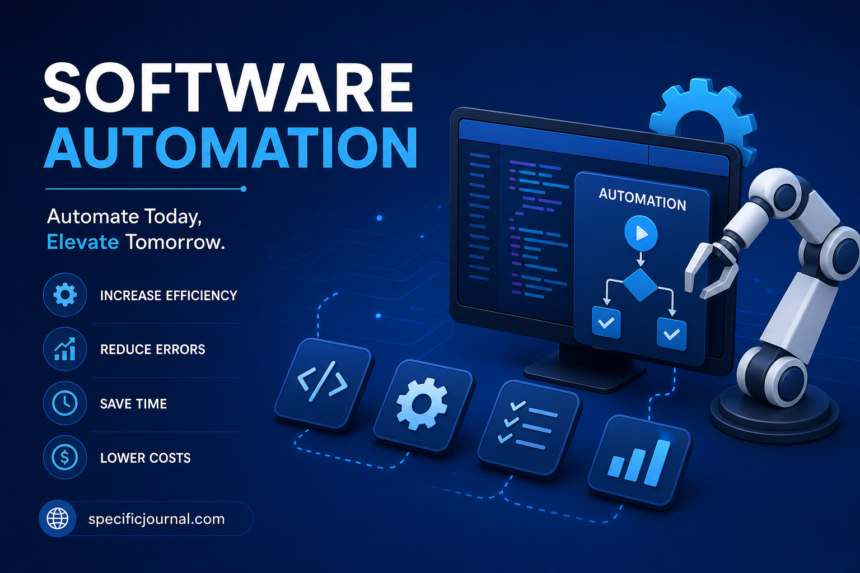
At its core, software automation means using software to perform repetitive or rule-based tasks with reduced human intervention. That can involve moving information between applications, triggering workflows, generating reports, processing data, or coordinating tasks across systems.
What Is Software Automation?
Software automation replaces repeated manual actions with predefined software logic.
For example, instead of an employee copying information from a web form into a spreadsheet and then sending a notification manually, an automated workflow can perform those steps after the form is submitted.
Common examples include:
- Moving data between business applications
- Sending automatic email notifications
- Creating records when a form is submitted
- Generating recurring reports
- Routing support requests
- Updating project-management tasks
- Scheduling recurring processes
- Extracting information from documents
- Monitoring workloads and triggering actions
The technology can range from simple scripts to connected workflow platforms and larger business-automation systems. IBM, for example, describes business automation in terms of capabilities such as workflow, decisions, content management, and data capture.
What Does “Wbsoftwarement” Mean?
This is where the keyword becomes less straightforward.
Wbsoftwarement appears in current search results primarily as the name associated with wbsoftwarement.com. That website describes itself as a technology and software-information platform covering software development, technology trends, product reviews, and practical software guidance.
Its dedicated page is titled “Software Automation Wbsoftwarement” and discusses automation as a way to reduce repetitive work such as data entry, file transfers, status updates, and email handling.
However, that does not establish “wbsoftwarement” as a separate automation technology.
Based on the available evidence, it is more accurate to understand the keyword as a combination of:
software automation + wbsoftwarement
rather than assuming that “wbsoftwarement” is the name of a particular automation product.
How Software Automation Works
Most automation follows a simple pattern:
Trigger → Rules or Logic → Action → Result
For example:
- A customer submits an online form.
- The system detects the submission.
- Automation checks the information.
- A customer record is created.
- The appropriate employee receives a notification.
The same basic idea can be used for much more complicated processes involving several applications.
Integration platforms are one example. Zapier currently describes its service as connecting applications so users can automate workflows between them, with thousands of available app connections.
Common Types of Software Automation
Software automation isn’t one single technology. Different approaches solve different problems.
Workflow Automation
Workflow automation connects multiple steps into a defined process.
A simple example could be:
New lead → CRM record → notification → follow-up task
This is useful when the same sequence happens repeatedly.
Robotic Process Automation
Robotic Process Automation (RPA) is designed for repetitive computer-based tasks. It can interact with existing software interfaces and perform actions that would otherwise require someone to repeatedly click, type, copy, and paste.
RPA can be particularly useful when older applications don’t provide convenient modern integrations.
Application Integration
Sometimes the problem isn’t the task itself. It’s that two applications don’t communicate with each other.
Integration tools can move information between services through APIs and other connections. This allows a change in one system to trigger an action in another.
For example, a completed form might automatically create a customer record in a CRM.
IT and Workload Automation
Automation also operates behind the scenes in IT environments.
IBM’s Workload Automation documentation describes systems that automate, monitor, and control workflows across enterprise IT infrastructure.
These systems can manage scheduled workloads and coordinate processes across different environments.
Why Businesses Use Automation
The main reason organizations automate is straightforward: repetitive work consumes time and creates opportunities for inconsistent execution.
Automation can help with:
- Consistency: The same defined steps can run repeatedly.
- Speed: Software can execute routine processes without waiting for manual action.
- Scalability: Automated workflows can handle increasing volumes without requiring every step to be performed manually.
- Integration: Information can move between connected systems automatically.
- Visibility: Some automation platforms provide logs, monitoring, or workflow status information.
But automation isn’t automatically beneficial. A badly designed process can simply become a badly designed automated process.
What Software Automation Cannot Replace
Automation works particularly well when a task follows clear rules.
It becomes more complicated when a process requires judgment, ambiguous information, unusual exceptions, or human communication.
For example, automatically sending a confirmation email is relatively straightforward. Deciding how to handle an unusual customer complaint may require context and human judgment.
That’s why automation should generally be viewed as a way to handle appropriate tasks, rather than as a blanket replacement for every human activity.
How to Decide What to Automate
If you’re considering automation, start with the process rather than the software.
Look for tasks that are:
- Repeated frequently
- Time-consuming
- Based on clear rules
- Prone to repetitive manual errors
- Dependent on copying information between systems
- Easy to measure before and after automation
Then document the current process.
Ask:
- What starts the process?
- What steps are performed?
- Which applications are involved?
- Where do errors occur?
- What exceptions require human judgment?
- What result should the automated workflow produce?
This prevents a common mistake: buying an automation tool before understanding the problem.
Is Software Automation Wbsoftwarement a Specific Software Tool?
There is not enough reliable evidence in the sources reviewed to identify “software automation wbsoftwarement” as a standalone software product or recognized automation framework.
The exact phrase does appear on wbsoftwarement.com, where it is used as the title of an article about software automation.
Other websites have subsequently published pages targeting the same phrase, generally treating it as a broad term for automation rather than documenting a distinct product with independently verifiable specifications.
That distinction is important if you’re researching the term because claims about pricing, features, integrations, customer numbers, performance, or official product status should not be assumed without documentation from a verifiable source.
What to Look For Before Choosing an Automation Solution
If your real goal is to automate a business or personal workflow, evaluate the actual technology rather than the keyword.
Check whether the solution supports:
- The applications you already use
- The triggers and actions your process requires
- API or native integrations where appropriate
- Error handling and notifications
- Access controls
- Activity logs
- Testing before deployment
- Ongoing maintenance
- Appropriate data-security controls
For simple app-to-app workflows, an integration platform may be enough. More complicated processes may require RPA, workflow-management software, custom development, or a combination of technologies.
The Bottom Line
Software automation is an established technology concept: software performs repetitive or rule-based tasks with less manual intervention. It covers everything from simple scripts and application integrations to enterprise workflow and workload automation.
“Software automation wbsoftwarement,” however, appears to be a search phrase associated with wbsoftwarement.com rather than a clearly established standalone automation technology. The safest interpretation is therefore to treat the keyword as referring to software automation in the context of wbsoftwarement, not as proof of a separate software product.
If you’re researching the term because you want to automate a real workflow, focus first on the process you want to automate and then identify the technology that actually fits that process.